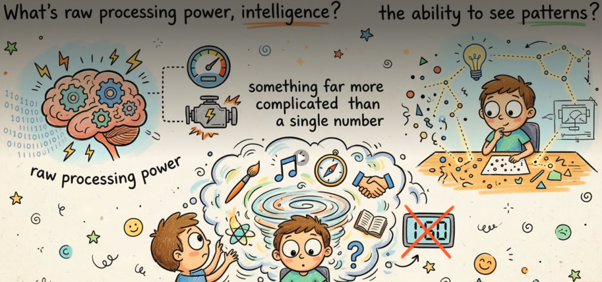
When people hear the term IQ, they often think it measures how “smart” someone is. In reality, IQ is much more specific than that.
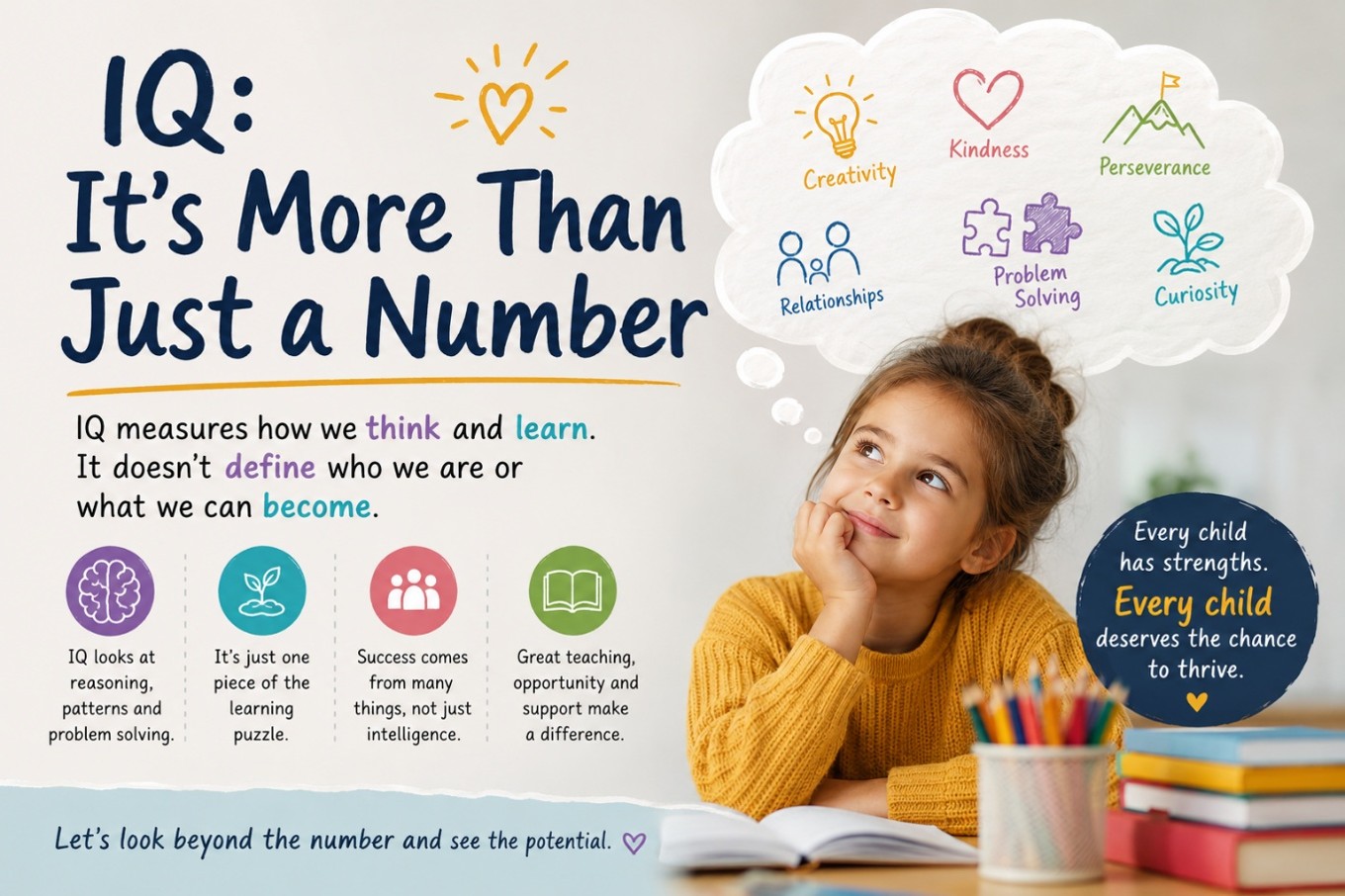
An IQ (Intelligence Quotient) score is designed to measure how a person thinks and learns. It looks at abilities such as reasoning, recognising patterns, solving unfamiliar problems and processing information. It is not a measure of creativity, kindness, determination, resilience, leadership or character – and it certainly does not define a person’s future.
What does an IQ score tell us?
Psychologists use IQ assessments to better understand how a person’s brain processes information. For children, this information can help identify learning strengths, recognise when additional support may be needed, or determine whether a student would benefit from greater academic challenge.
Like a growth chart or a vision test, an IQ assessment provides one piece of information. It helps us understand how a child learns, but it never tells the whole story.
High IQ doesn’t guarantee success
Many people assume that a high IQ automatically leads to outstanding achievement. While strong reasoning ability can make learning easier, success depends on much more than intelligence alone.
Curiosity, motivation, perseverance, opportunities to learn, supportive relationships and quality teaching all play an important role in helping children reach their potential.
Similarly, some highly capable students may not appear to be achieving at expected levels because they are living with anxiety, learning differences, disability or other barriers. This is why educators consider many different sources of information when making decisions about learning.
Every child has strengths
One of the biggest misconceptions about IQ is that it places children into fixed categories.
In reality, every child has unique strengths, interests and talents. Some excel in mathematics or language, while others shine in music, sport, leadership, creativity or problem-solving. Many of these strengths are not measured by an IQ assessment.
Our role as parents, carers and educators is not to focus on a number, but to discover what helps each child thrive.
Why schools sometimes use IQ assessments
Schools may use cognitive assessments as part of a broader process to better understand a student’s learning profile.
These assessments can help identify:
- students who may benefit from extension or enrichment;
- students whose achievement does not match their cognitive potential;
- twice-exceptional (2e) learners – students who are both highly capable and have a disability or learning difference; and
- appropriate learning pathways and supports.
Importantly, decisions are never based on one test alone. Teacher observations, classroom achievement, student voice and family insights are all valuable pieces of the puzzle.
Looking beyond the score
Perhaps the most important thing to remember is that an IQ score does not define a child.
Children continue to grow, develop and discover new strengths throughout their lives. Confidence, resilience, creativity, compassion and determination are qualities that cannot be captured by a single number, yet they are often the qualities that shape success and fulfilment.
Every child deserves learning that challenges them, supports them and allows them to flourish.
A final thought
Rather than asking, “How intelligent is this child?” perhaps the better question is:
“How can we best support this child to develop their unique potential?”
That is where the real power of education lies.
Further Reading
Beyond Gifted. What Psychologists Want You to Know About IQ.
Sternberg, R. J. (2021). IQ is NOT Intelligence and Neither Are Other Test Scores. Cambridge University Press.
Post, G. (2024). Beyond High IQ: Why Giftedness Is Not Just a Number. Psychology Today.